Jeevy Industrial OS: Digitizing Heavy Aerospace Fabrication
Over a twelve-week solo engineering sprint in Cleburne, Texas, I designed and built Jeevy OS from scratch as Lead Product Designer & Systems Architect. The system serves as the central operating system for heavy fabrication facilities building multi-ton cryogenic process skids and commercial orbital launch infrastructure.

Completed cryogenic process skid package staged in Cleburne, Texas, and dispatched to a commercial launch customer’s pad.
The reality on the fabrication floor
In industrial manufacturing, software failure isn’t an abstract metric or a dropped page view. It’s an idle welding crew, a halted overhead gantry crane, and a five-figure expedited freight penalty when a dispatch window gets missed.
Before this overhaul, our primary tool for managing high-value bills of materials was a 15-tab Google Sheet. It was tracking $800,036.25 in raw materials across structural steel, piping, valves, and instrumentation. A single accidental edit in a formula cell would silently distort profit margins across an entire build, and when steel actually arrived at the dock, inventory was tracked on dry-erase whiteboards that buyers in the front office never saw.
Software designed in quiet tech offices assumes clean hands, 4K monitors, and precision mice. The Cleburne fabrication hangar is the exact opposite.
Work gloves. Welders and fitters wear thick leather gauntlets. A standard 20px button or micro-dropdown cannot be tapped.
High-bay glare. Massive metal-halide overhead lights wash out subtle grey-on-grey UI palettes into unreadable smears.
Hangar acoustics. Plasma cutters and grinders make shouting across the shop impossible; blockers have to be communicated digitally and asynchronously.
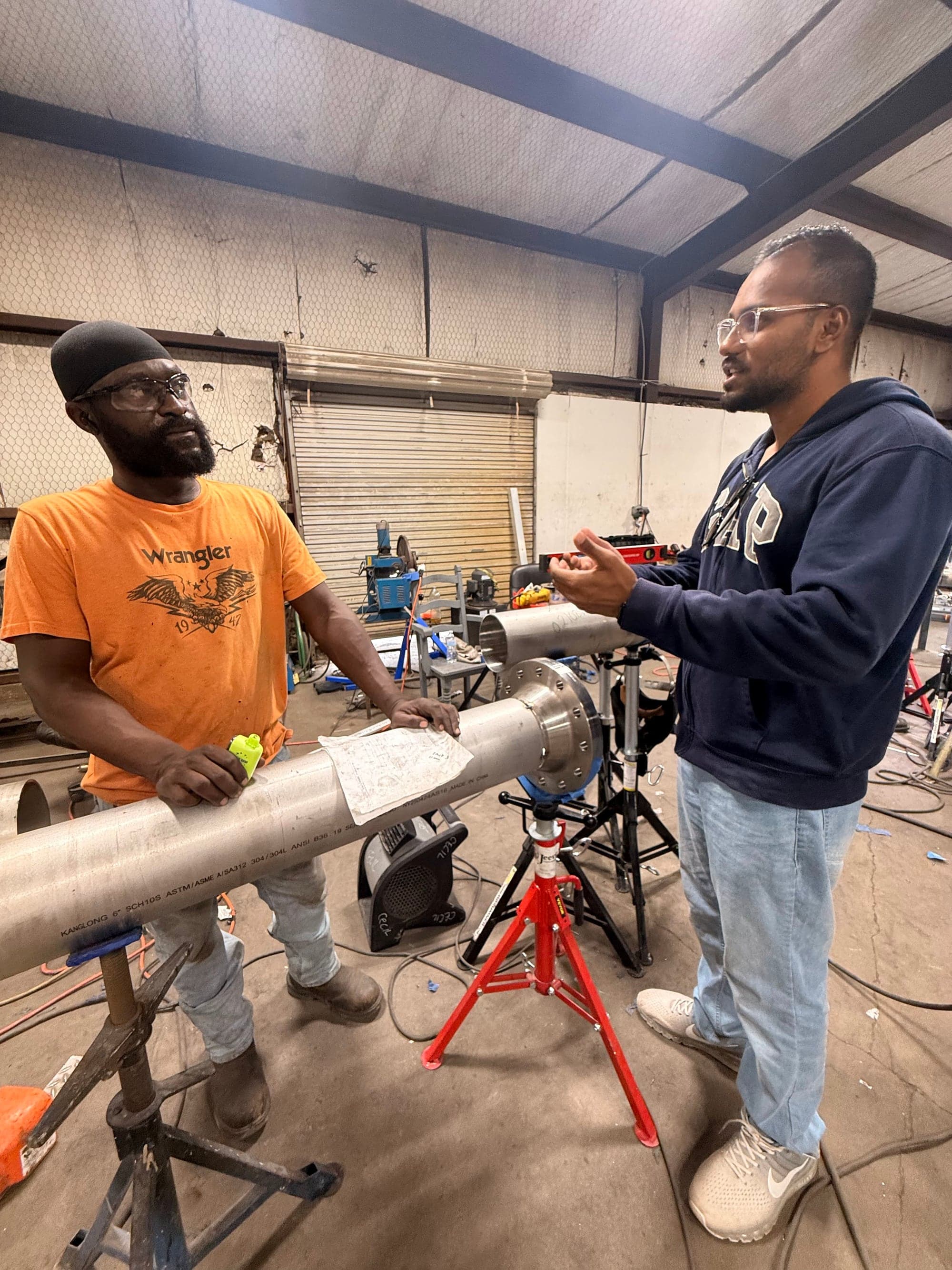
Field research in the Cleburne welding bays, testing touch targets and mapping physical-digital communication breakdowns.
Designing the closed loop
I didn’t start in Figma. I spent my first weeks on the floor talking to Trevor Goldston, our Shop Operations Lead, and the welding crew.
I realized that treating procurement as an accounting chore was why industrial software fails. Sourcing, inventory, blueprints, and critical-path scheduling are not separate departments; they are a single physical loop.
I architected Jeevy OS around one non-negotiable invariant: steel dictates the schedule. Most manufacturing tools treat inventory as a passive list, but in our Gantt Critical Path engine, verified dock delivery dates act as hard scheduling predecessors. A weld task cannot be scheduled for Tuesday if the pipe flange is still on a freight truck arriving Thursday.
To make this work across the whole facility, I designed and implemented six compounding modular engines.
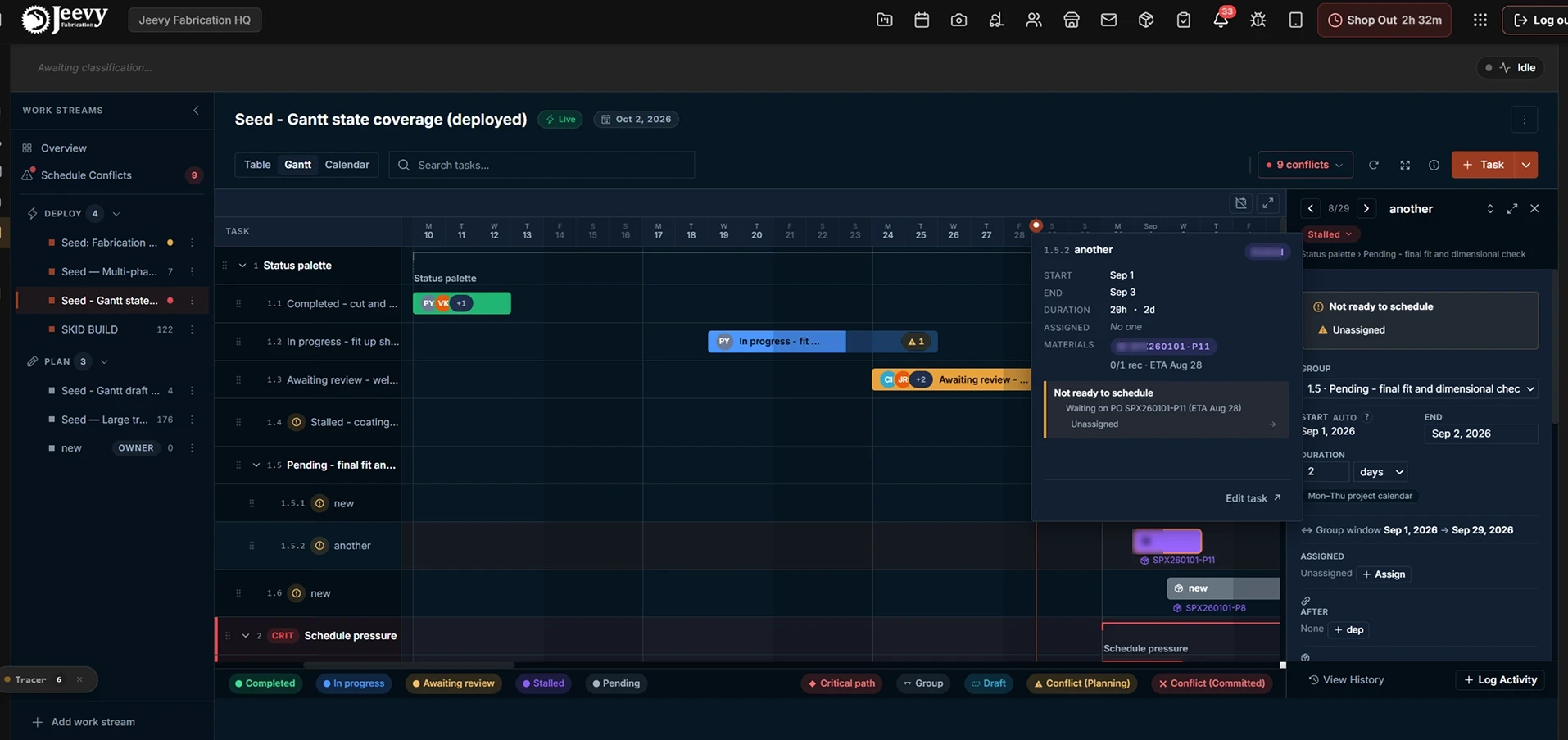
The production Gantt timeline showing stalled task bars floored automatically by supplier delivery ETAs.
Reconciling design tokens with physics
To make the interface survive contact with the shop floor, I built and published the Jeevy Industrial Design System.
I authored 101 semantic tokens grounded in strict ergonomic rules.
The monotonic surface ladder. In a high-glare hangar, drop shadows disappear and look like dirt smudges. Elevation is communicated strictly through stepped background lightness, from the app shell up through canvas, surface, and hover.
The 44px glove touch contract. Buttons maintain a dense 28px visual height in table rows while extending an invisible 44px hit boundary via pseudo-elements, so operators in welding gloves never mis-tap.
Terracotta as a scalpel. I restricted primary action accents to one button per surface, de-escalating table elements to neutral outlines to prevent visual fatigue.
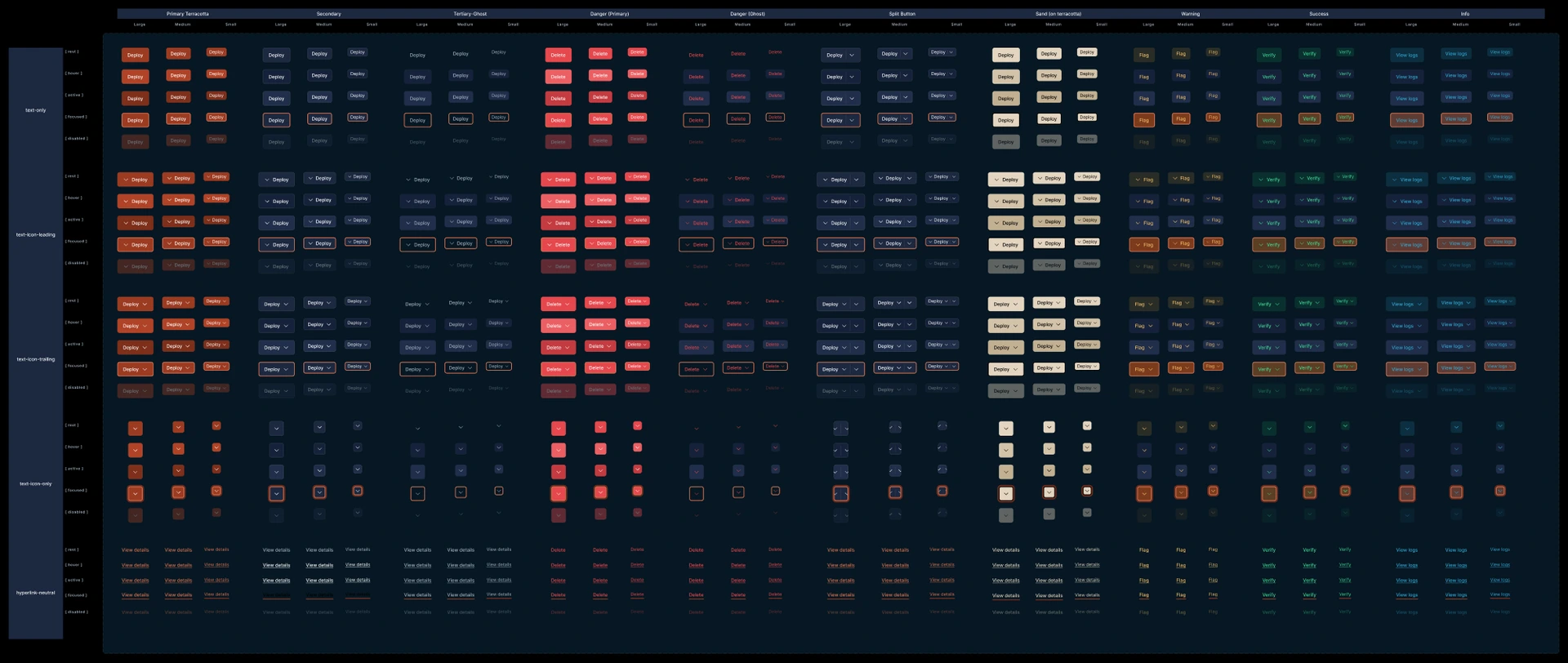
The button coordinate matrix in Figma: 750 token-bound variants mapped across 10 styles, 3 sizes, and 5 interactive states.
Scaling to partner shops, and what it taught me
Deploying software into a second fabrication plant is the real test of systems architecture. When we rolled out Jeevy OS to our partner manufacturing plant, shop leads didn’t want custom forks; they wanted immediate clarity. Features like dynamic Notion-style blueprint callout columns and 1-to-N raw plate nesting gave them flexibility without touching the database schema.
Leading this build solo reinforced that enterprise design is fundamentally systems architecture. A sleek modal cannot fix a broken data schema, and a pretty status badge cannot stop an unapproved $50k spend leak. When you align database check constraints and physical shop-floor constraints under one rhythm, software becomes an operational multiplier.
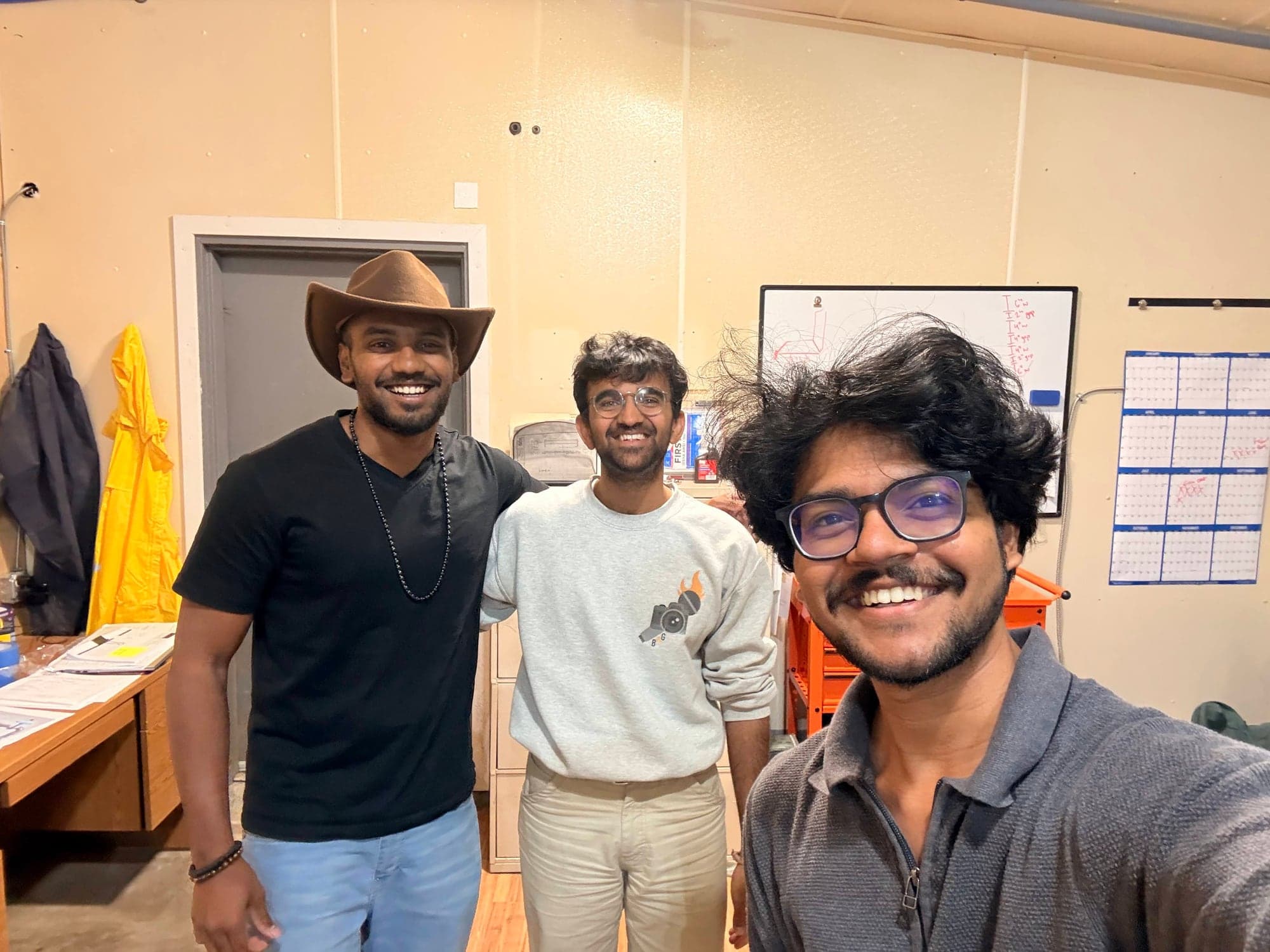
Vinay Konuru (VP Technology), Sai Tangudu (Engineering), and Pradeep Y. on-site at the Cleburne fabrication plant.
The work splits into six deep-dive systems blueprints
How I replaced the $800k manual Google Sheet with an immutable single-table PostgreSQL JSONB ledger, $1k server spend gates, 4-step unit QC, and 1-to-N bulk plate nesting.
Designing for the human holding the torch. Ephemeral 6-digit PIN logins, frozen unpaid break arithmetic, tri-state blocker notes, and a 275-key zero-drift bilingual contract.
Scrapping an abstract prototype to build Trevor's Windows Explorer mental model: sub-second 2D/3D browser inspection, stacked revisions, and 3-gate role security.
101 semantic tokens, an anti-glare monotonic surface ladder, and what migrating 31 dense production files taught us about token-pipeline discipline.
Integrating supply transit dates directly into forward Gantt scheduling, plus cross-project Available-to-Promise (ATP) inventory pooling.
The North Star: a Miro-style infinite canvas where managers map physical skid assemblies once to automatically derive tasks, milestones, and real-time Sankey cash-flow flows.